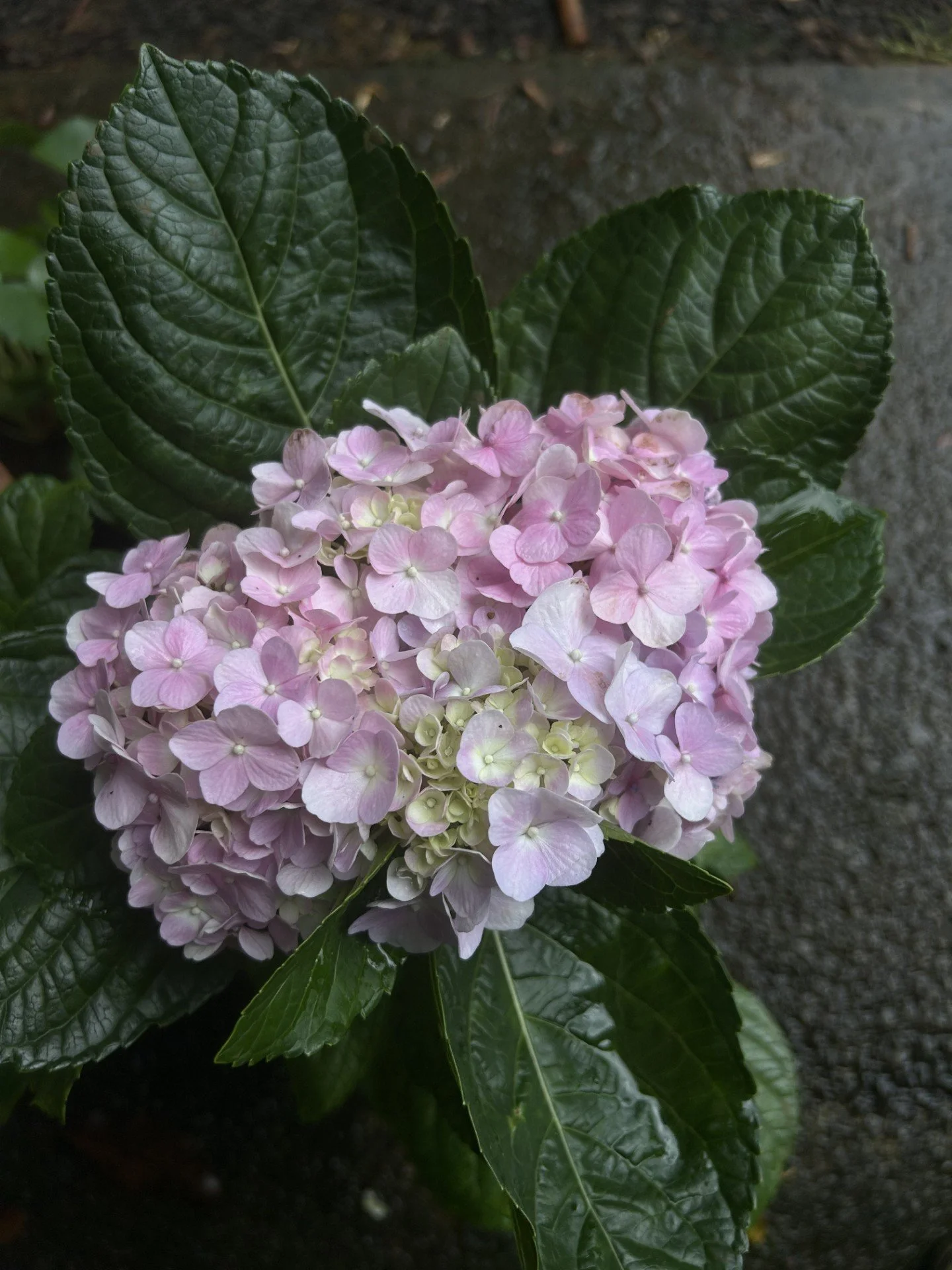
Hydrangea is a genus of more than 70 species of flowering plants that are native to Asia and the Americas. These fast-growing shrubs can be found with a variety of leaf shapes, flower composition, and flower colors. Commonly found in gardens on the mainland, most notably in coastal areas in the Northeast, Hydrangea show off their big, bushy blooms in the summertime through the fall. Some Hydrangea flowers can even get up to one foot in diameter!
Not all Hydrangea varieties are compatible with the tropical climate in Hawai’i. Some Hydrangea require a cold period to bloom the following year. Many varieties also require heavy shade to prevent leaf scorch. Here on Kaua’i, the Bigleaf Hydrangea (Hydrangea macrophylla) grows up in the mountains of Koke’e at high elevation, and can even be grown at lower elevations in your own backyard!
Hydrangeas can grow two feet every year, making them rapid growers in the landscape. Bigleaf Hydrangea can handle full sun in cooler areas, but hotter areas do better with morning sun and afternoon shade. Hydrangeas need rich soil and consistent moisture to thrive, and the pH level in the soil can actually determine the color of your blooms.
Hydrangeas are typically found with flowers in shades of white, red, pink, blue, purple, and green. More acidic soil turns the blooms blue. Soil with a neutral pH turns the blooms lavender, and a high pH turns the flowers pink. White varieties typically remain white regardless of pH. Flowerheads of Hydrangea actually contain two types of flowers: small, fertile flowers in the interior of the flowerhead and large, showy flowers with colorful sepals.